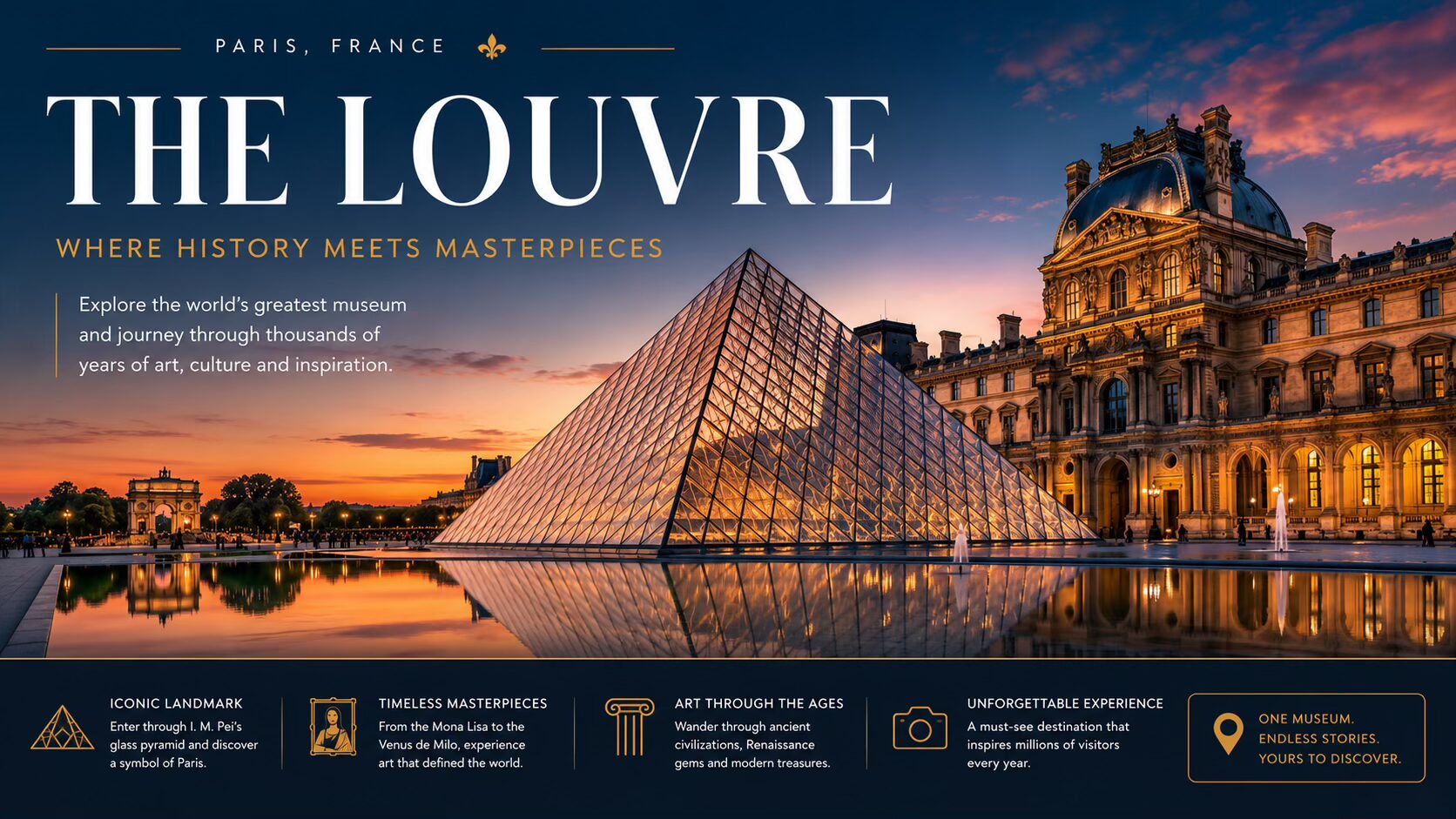
Few places on Earth inspire travelers quite like the Louvre. Located in the heart of Paris, the Louvre is not only the most visited museum in the world but also one of humanity’s greatest cultural achievements. Behind its elegant palace walls lies an extraordinary collection spanning thousands of years of history, from ancient civilizations to masterpieces of the Renaissance.
Whether you are an art lover, a history enthusiast, or simply a curious traveler, a visit to the Louvre is an unforgettable experience that reveals the story of human creativity across centuries.
A Palace Before It Became a Museum
Long before it became a museum, the Louvre began life as a medieval fortress in the late 12th century. Over the centuries, French kings transformed the structure into a magnificent royal palace. Its architecture reflects different eras of French history, blending medieval foundations, Renaissance elegance, and classical grandeur.
Following the French Revolution, the palace was converted into a public museum in 1793. What was once reserved for royalty became a place where everyone could admire the finest artistic achievements of mankind.
Today, the Louvre welcomes millions of visitors every year and remains one of the most iconic landmarks in Paris.
The Famous Glass Pyramid
For many visitors, the journey begins at the museum’s striking glass pyramid. Designed by architect I. M. Pei and inaugurated in 1989, the pyramid sparked controversy when it was first unveiled. Today, however, it has become one of Paris’s most recognizable symbols.
The contrast between the modern glass structure and the historic palace perfectly represents the Louvre itself—a place where ancient history and contemporary culture coexist.
As sunlight filters through the pyramid into the underground entrance hall, visitors are reminded that the museum is far more than a collection of paintings; it is a gateway into the story of civilization.
Home of the Mona Lisa
No artwork attracts more attention than Leonardo da Vinci’s Mona Lisa. Protected behind glass and viewed by thousands of visitors daily, the painting remains one of the most famous and mysterious works ever created.
Its popularity comes not only from Leonardo’s extraordinary technique but also from the enigmatic smile that has fascinated generations. Standing before the Mona Lisa is often a highlight of any trip to Paris.
Yet many first-time visitors are surprised by the painting’s relatively modest size. The true magic lies in its subtle details, delicate shading, and timeless expression.
Masterpieces Around Every Corner
While the Mona Lisa may be the star attraction, the Louvre offers countless treasures beyond its most famous resident.
Among the museum’s highlights are:
- Venus de Milo, one of the most celebrated sculptures of Ancient Greece.
- Winged Victory of Samothrace, dramatically displayed atop a grand staircase.
- Liberty Leading the People by Eugène Delacroix, a powerful symbol of freedom and revolution.
- The Coronation of Napoleon by Jacques-Louis David, an enormous masterpiece depicting one of France’s defining historical moments.
- Ancient Egyptian artifacts, including statues, sarcophagi, and mummies that transport visitors thousands of years into the past.
Each gallery reveals another chapter in the story of humanity, making every visit feel like a journey through time.
Exploring Eight Centuries of Art
The Louvre’s collection contains more than 35,000 works on display, covering civilizations from across the globe. Visitors can explore:
- Ancient Egypt
- Ancient Greece and Rome
- Near Eastern civilizations
- Islamic art
- European paintings
- Decorative arts
- Sculptures
- Prints and drawings
Because of its enormous size, it is impossible to see everything in a single day. Many travelers choose to focus on specific sections or return multiple times during their stay in Paris.
Tips for Visiting the Louvre
To make the most of your visit:
- Book tickets in advance to avoid long queues.
- Arrive early in the morning or later in the evening when crowds are smaller.
- Plan a route before entering, especially if you have limited time.
- Wear comfortable shoes, as the museum covers a vast area.
- Allow at least three to four hours for a meaningful visit.
Even with careful planning, you will likely leave feeling that there is still more to discover.
Why the Louvre Belongs on Every Traveler’s Bucket List
The Louvre is far more than a museum. It is a celebration of human imagination, achievement, and cultural heritage. Every corridor, gallery, and masterpiece tells a story that connects visitors with civilizations separated by thousands of years.
Whether you come to admire the Mona Lisa, marvel at ancient sculptures, or simply experience one of Paris’s most iconic landmarks, the Louvre offers an unforgettable encounter with the world’s artistic legacy.
In a city filled with extraordinary attractions, the Louvre remains the crown jewel of Paris—a destination that continues to inspire travelers from every corner of the globe.