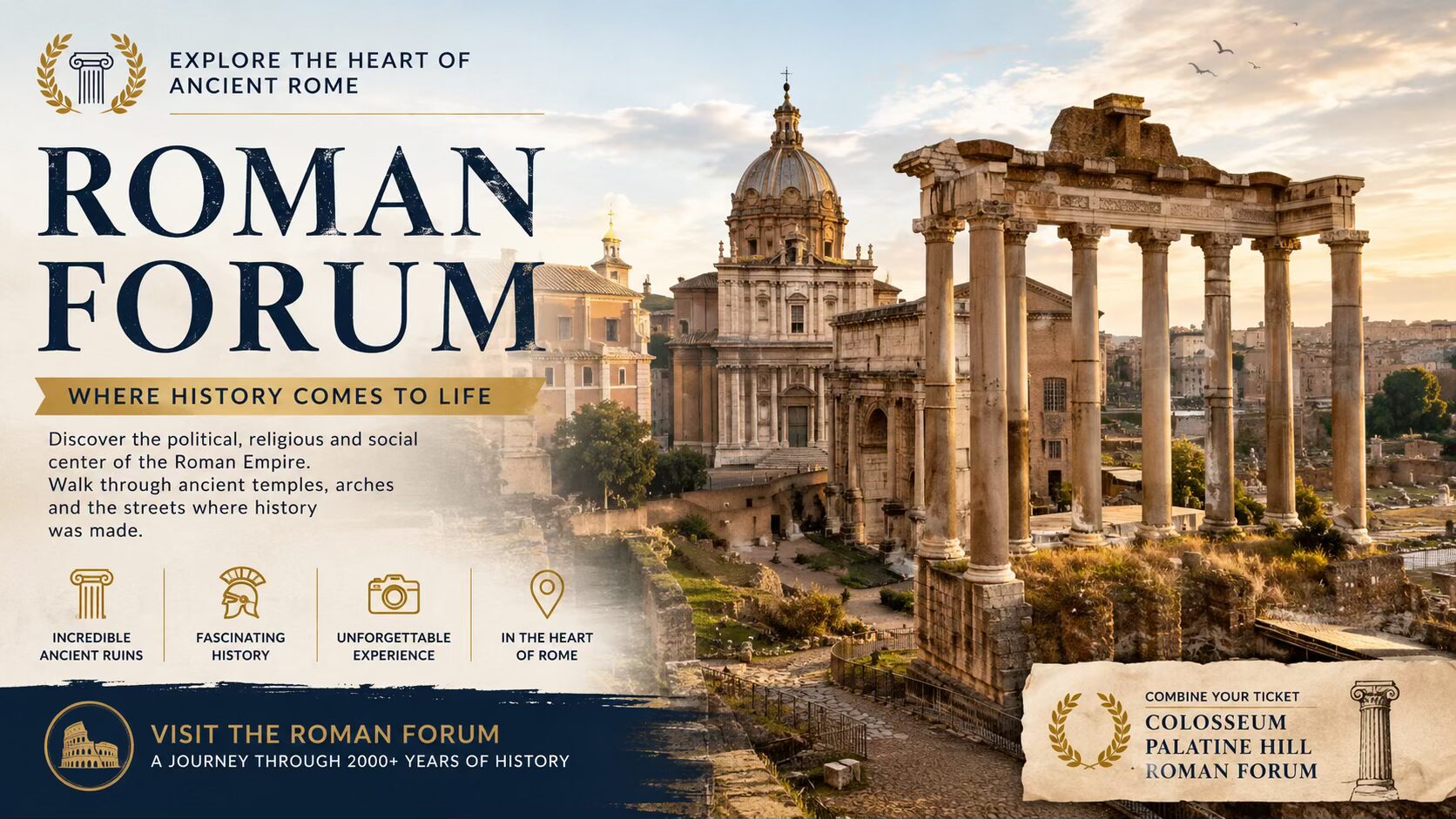
The Roman Forum, known in Italian as Foro Romano, is one of the most important archaeological sites in the world and a must-visit attraction in Rome. Once the political, religious, and commercial center of the Roman Empire, the Forum offers visitors a fascinating journey through more than a thousand years of history.
What Is the Roman Forum?
Located between the Palatine Hill and the Capitoline Hill, the Roman Forum was the beating heart of ancient Rome. From the 7th century BC until the fall of the Roman Empire, it served as the city’s main public square, where citizens gathered for elections, public speeches, religious ceremonies, and major political events.
Today, the Forum is an open-air archaeological park filled with the remains of temples, basilicas, government buildings, and monuments that tell the story of one of history’s greatest civilizations.
History of the Roman Forum
The area that became the Roman Forum was originally a marshy valley. Early Romans drained the land using an advanced sewer system known as the Cloaca Maxima, transforming it into a central gathering place.
As Rome expanded from a small city-state into a vast empire, the Forum grew with it. Emperors and politicians commissioned grand temples, triumphal arches, and public buildings to showcase Rome’s power and prosperity.
For centuries, the Forum was the center of Roman public life. However, after the fall of the Western Roman Empire in the 5th century, many structures fell into ruin. Over time, the area became buried beneath layers of earth until major excavations began in the 18th and 19th centuries.
Top Attractions in the Roman Forum
Temple of Saturn
One of the most recognizable landmarks in the Forum, the Temple of Saturn once housed the treasury of the Roman Republic. Its iconic columns remain a symbol of ancient Rome.
Arch of Septimius Severus
Built in AD 203, this impressive triumphal arch commemorates the military victories of Emperor Septimius Severus and his sons. Detailed carvings depict scenes from Roman campaigns.
Curia Julia
The Curia Julia served as the meeting place of the Roman Senate. It is one of the best-preserved buildings in the Forum and provides a glimpse into the political life of ancient Rome.
Temple of Antoninus and Faustina
Constructed in the 2nd century AD, this temple was later converted into a Christian church, helping preserve much of its original structure.
House of the Vestal Virgins
This large residence housed the Vestal Virgins, priestesses responsible for maintaining the sacred flame of Rome. The complex offers insight into the religious traditions of the ancient city.
Interesting Facts About the Roman Forum
- Julius Caesar’s funeral took place in the Forum after his assassination in 44 BC.
- The famous Via Sacra, or Sacred Way, ran through the Forum and was used for triumphal processions.
- The Forum remained the center of Roman life for over a millennium.
- Archaeologists continue to make discoveries in the area, revealing new details about daily life in ancient Rome.
Visiting the Roman Forum
The Roman Forum is located in the historic center of Rome and is typically visited together with the Colosseum and Palatine Hill. Combined tickets often provide access to all three attractions.
To avoid large crowds, consider visiting early in the morning or later in the afternoon. Comfortable walking shoes are highly recommended, as the site covers a large area with uneven ancient pathways.
Why Visit the Roman Forum?
Few places in the world allow travelers to walk through the actual center of an ancient empire. The Roman Forum offers a unique opportunity to experience the history, architecture, and culture that shaped Western civilization. Whether you are passionate about history or simply exploring Rome’s most famous landmarks, the Forum is an unforgettable destination that brings the ancient world to life.